

Introduction
To develop and host a Nuxt application on Square Cloud, it’s essential to follow a structured sequence of configurations and prerequisites. This technical guide will cover the entire process, from initial setup to production deployment.Prerequisites
- Square Cloud Account: Register through the signup page using your email.
- Active plan: Ensures dedicated resources and optimized performance for your application. Check our available plans and choose the most suitable for your needs.
Create the project
You need Node.js and npm on your machine. If you don’t have them, download them from the official Node.js website. Create a project with the official initializer, which replacesnuxi init:
http://localhost:3000. Edit app/app.vue to change the home page, or create app/pages/index.vue to use file-based routing.
Build for production
.output folder. Its entry file is .output/server/index.mjs, and .output/server carries its own dependencies.
Port and host
Nothing to change in Nuxt: the Nitro server reads thePORT and HOST environment variables, which Square Cloud sets to 80 and 0.0.0.0.
Configure Square Cloud
Create asquarecloud.app file at the root of your project and point MAIN to the Nitro server:
squarecloud.app
node .output/server/index.mjs. In the dashboard upload, set the same main file.
What goes in the ZIP
.output/, the production build.package.json,nuxt.config.tsand your source folders (app/,public/and the others your project has): on the first start, Square Cloud runsnpm install, and thepostinstallscript of Nuxt projects (nuxt prepare) needs them.squarecloud.app.
node_modules and .nuxt: they are regenerated on the server.
Static generation instead of a server
If every page can be generated at build time, runnpm run generate instead of npm run build. Nuxt writes a static site to .output/public, which the static runtime serves without a Node.js process:
The static runtime serves the files of your build with a web server managed by Square Cloud. No Node.js process runs, so it is the lightest way to host a site without server-side code.
1
Build the site
Run
npm run build. The output goes to the .output/public folder.2
Keep client-side routes working
If your app changes pages in the browser without a reload (client-side routing), rename
.output/public/index.html to vite.html. The static runtime answers every path that is not a file with vite.html, so refreshing a route such as /about still loads your app. A site with one HTML file per page keeps index.html: unknown paths then return your 404.html. See how the static runtime serves files.3
Add the configuration file
Create a Use
squarecloud.app file inside .output/public. A MAIN that points to an HTML file selects the static runtime:squarecloud.app
MAIN=index.html if you kept index.html. 512 MB is the minimum memory for a website. When you upload through the dashboard, it asks for these values and writes the file for you.4
Zip the build output
Zip the contents of
.output/public, not the folder itself, so that squarecloud.app sits at the root of the ZIP. With the CLI, run squarecloud upload from inside .output/public.nuxt generate prerenders one HTML file per page and a 404.html, so keep index.html (no vite.html rename).
Deploy and verify
Via dashboard
1
Access the Upload Page
Access the upload page and upload your project zip file.
2
Configure Your Environment
After uploading your zip, you will need to configure the name, main file or runtime environment and other settings for your project.
If you are uploading a web project, make sure to select “Web Publication” and set a subdomain to your project.
If you are uploading a web project, make sure to select “Web Publication” and set a subdomain to your project.
3
Deploy Your Project
Finally, click on the “Deploy” button to host your project on Square Cloud.
After deployment, you can monitor your project’s status and logs from the dashboard.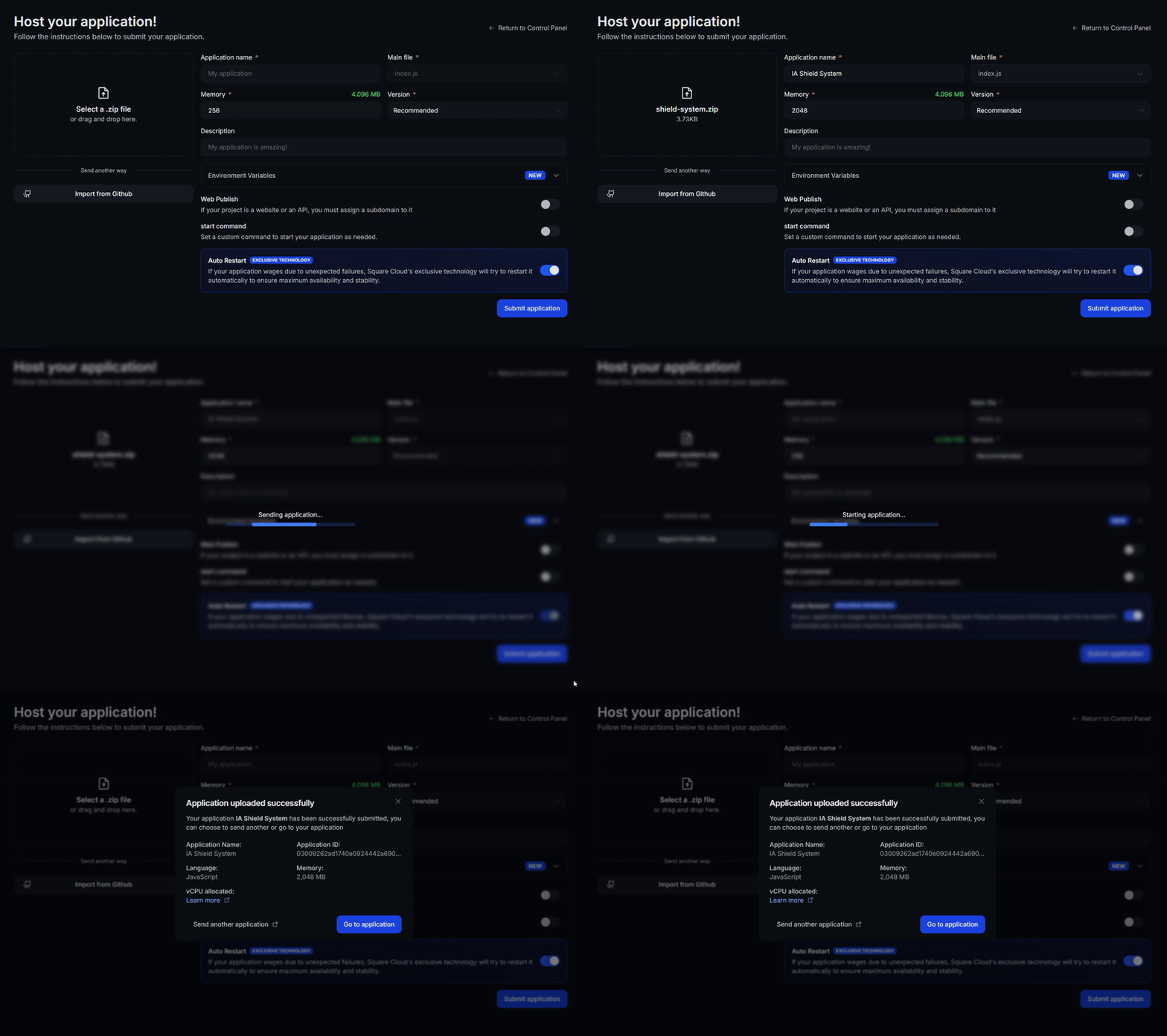
After deployment, you can monitor your project’s status and logs from the dashboard.
4
Confirm Your App Is Live
Your first deploy usually takes less than a minute. In the dashboard, wait for your application status to show as running and check the logs for any startup errors.
If you deployed a website or API, open
If you deployed a website or API, open
https://<your-subdomain>.squareweb.app in your browser: you should see your application responding. If you deployed a bot, send it a command to confirm it is online.
Via CLI
To use this method, your project needs a configuration file namedsquarecloud.app at its root. It tells Square Cloud how to run your application.
Configuration file guide
Learn how to create the
squarecloud.app configuration file that defines your application’s environment.1
Install the CLI
Install the Square Cloud CLI. If you already have it, run the same command to update it:
2
Log In
Run the command below. It opens your browser: approve the login there and the CLI is ready. There is no API key to copy. For scripts and CI, see CLI authentication.
3
Upload Your Project
From your project folder, run the command below. The CLI zips the current folder, leaving out what To upload a zip you created yourself, pass it with
squarecloud.ignore lists, and uploads it:--file:4
Confirm Your App Is Live
Your first deploy usually takes less than a minute. Check your application status and logs directly from the terminal:If you deployed a website or API, open
https://<your-subdomain>.squareweb.app in your browser: you should see your application responding. If you deployed a bot, send it a command to confirm it is online.
Common errors
Custom domain
To use a custom domain (e.g.,
mysite.com) instead of the default URL mysite.squareweb.app, you need the Standard plan or higher. The default URL comes from the SUBDOMAIN field in the configuration file. To connect your domain, follow how to set up your own domain.Minimum RAM requirements
Minimum: 512MB RAM for websites and APIs, enough for a static build on the static runtime. For apps that render pages on a server (Next.js, Nuxt, Angular SSR and similar), we recommend at least 1GB RAM. For larger applications, allocate more RAM to prevent the application from running out of memory and crashing.
Could not find this site.
Check if the subdomain/domain matches what’s configured in the SUBDOMAIN field or in the custom domain settings. If you just uploaded the site, wait up to 60 seconds for Square to enable first access.
Site took too long to respond…
Your server must listen on port 80 and host 0.0.0.0. Square Cloud sets the PORT (
80) and HOST (0.0.0.0) environment variables in your application: read them in your code instead of hardcoding other values. A server that listens only on localhost or 127.0.0.1 never receives requests.Cannot find module .output/server/index.mjs
The build is missing from the ZIP. Runnpm run build and check that the .output folder is at the root of the ZIP, next to squarecloud.app.
Next steps
Environment variables
Keep secrets and settings out of your code and read them at runtime.
Custom domain
Serve your app on your own domain, on the Standard plan and above.
Troubleshooting
Fix an app that does not start or a site that does not respond.